We’ve all heard the term “Vibe coding” which has emerged as a rapid, intuition-led development style. While creators can now iterate quickly using AI, they often bypass the structure, frameworks, and compliance gates that have formed over time via tenured DevOps environments. Being very effective for prototypes and demonstrations, this approach often produces “fragile” software that is functional, but unsecure, difficult to maintain and scale.
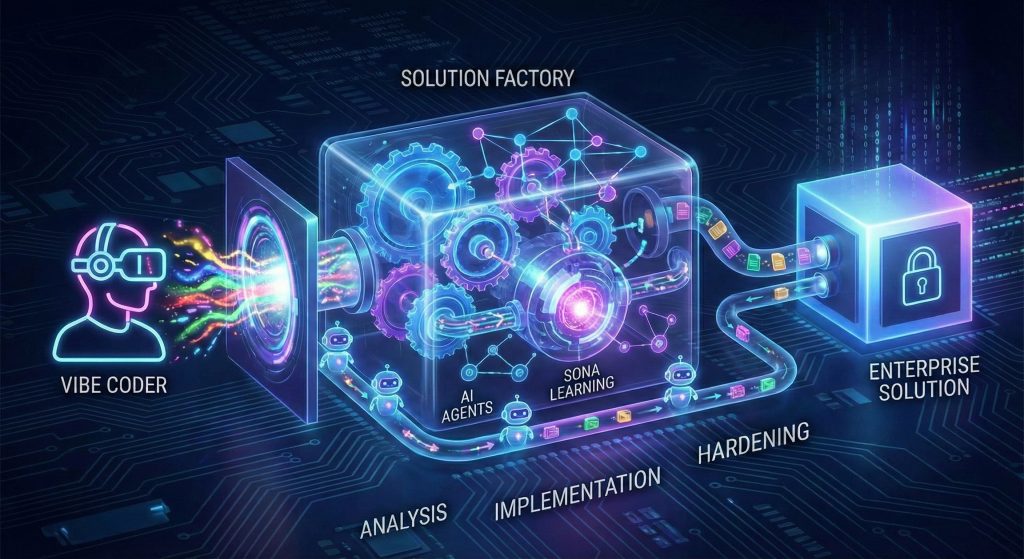
To introduce fundamental engineering practices to vibe coding projects, I have developed the aptly named Solution Factory, an enterprise-grade platform that provides the speed of vibe coding with industry standards guiding the production along the way. It allows for rapid iteration while weaving enterprise compliance, security, and architectural rigor directly into the build process .
Architecture: Structuring the Vibe
The platform imposes order through a split-plane architecture that separates intent from execution .
1. The Control Plane (Hosted Platform)
This is the governance layer. It uses a Standards RAG system to ground every project in reality. Before a single line of code is written, the system consults a knowledge base of security protocols, infrastructure patterns, and compliance requirements (e.g., GDPR, SOC2). This ensures that “vibes” don’t trump policy.
2. The Execution Plane (Local Workspace)
Development happens in isolated Docker containers (per-ticket sandboxes). Inside these sandboxes, a Claude Agent Swarm operates with distinct roles – Architect, Security, Test, and Build – ensuring separation of concerns.
The Core Innovation: SONA Learning & Evolutionary Memory
The critical differentiator of the Solution Factory is its ability to learn. It utilises a SONA (Self-Organising Neural Architecture) learning element that operates at two levels:
- Local Learning (Inside the Container): Within a specific project, agents utilise GNN-enhanced search to improve retrieval quality as they iterate. Complex relationship reasoning via Cypher queries allows them to understand dependencies between code modules and compliance rules.
- Global Evolution (The Factory Level): The system implements a Hierarchical Memory structure. When a project succeeds, the agents identify successful patterns and promote them to the global memory. This means the Factory gets smarter with every request ticket it processes – reusing proven architectures and security mitigations while maintaining crucial per-sandbox isolation to prevent context bleed.
The Automated Workflow
The development process is not an agentic AI free-for-all but a structured, 5-phase pipeline designed to mimic a high-maturity engineering team:
- Analysis: The Architect Agent designs the system, while the Security Agent simultaneously models threats and the Test Agent devises a strategy.
- Implementation: Code is generated in iterative bursts with automated review loops to catch errors early on.
- Hardening: This is where “vibe” meets “rigor.” The system executes tests, runs security scans, and verifies compliance against the Standards RAG.
- Consultation: A preview deployment is generated for human feedback, ensuring the solution matches the user’s original intent.
- Build & Release: The final artifacts are signed and automatically released to a GitHub repository for access and collection.
Guardrails: Keeping the Human-in-the-Loop
In order to prevent “hallucinated” solutions, the platform includes a defined escalation protocol. The system stops, then requests human intervention if:
- Loop iterations exceed defined thresholds (preventing infinite retry loops).
- Critical security vulnerabilities or compliance violations are detected.
- Agents cannot reach a consensus on the implementation.
This approach transforms “vibe coding” from a hobbyist hack into a scalable, self-improving software manufacturing process. For enterprises, this can be hosted on-premise to let their innovation teams experiment and develop useful products to either boost internal efficiency or take new products to market.